
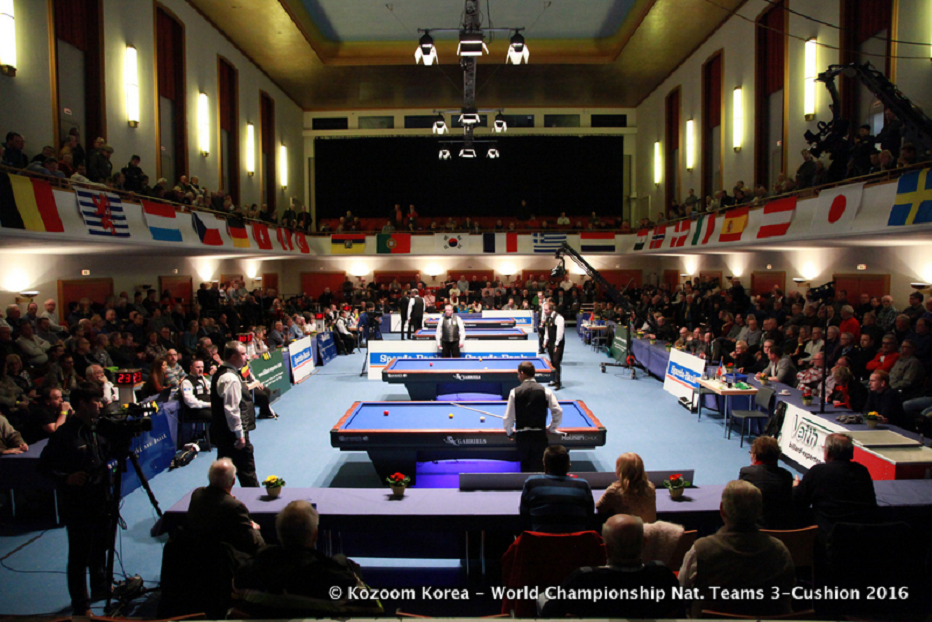
VIERSEN - The playing room, the stands and the entourage are prepared for the new edition of the World championship three-cushion for national teams. The Dutch team defends its title in the famous Festhalle in Viersen, where fans and spectators get ready for a prestigious battle, starting Thursday (9th of March) to Sunday (March 12).
The tournament will be dominated by the Scotch Double system, that should make the matches faster, to make more flashy and more spectacular. The World championship is played with 24 teams from 22 countries spread over four continents. The well-known billiards countries are present with the exception of Vietnam.
The world top is searching for the spotlights with Dick Jaspers, Frédéric Caudron, Marco Zanetti, Tayfun Tasdemir, Sung-Won Choi, Sameh Sidhom, Robinson Morales and other big name players. The world champion Dani Sánchez, Eddy Merckx and Haeng-Jik Kim are the major names missing.
The Scotch Double system is used for the first time from the preliminaries to the finals. Kozoom CEO Xavier Carrer, who is one of the promoters of the system: ,,I know many fans don't like the Scotch Double. When the UMB introduced it two years ago for the knock-out stage, the idea was to not judge it before we had seen how it worked. This week too, we'll have to see how it goes. As for me, I find it exciting to see how the teams deal with it, and which tactic they come up with. It is no less than a small revolution in billiards, but nobody can deny that innovation is a thing we badly need.’’
The matches have a length of 40 points. As in tennis or badminton doubles, the four players are all at the table. Players are expected to form a solid unity. They are allowed to consult each other about the positions on the table. The averages are no longer individual, they are the team result. A world class player can't win all by himself. He's at the table as often as his partner.
The top players in their comments:
Martin Horn, lead player of his country: ,,The WC in Viersen is like Wimbledon in tennis, or the German Cup final in soccer. The best players represent their country and battle for medal. The atmosphere in Viersen is unlike anywhere else. I always play with eagerness and maximum motivation there. I was very surprised when the UMB announced the new format, but we'll have to give it a chance. We plat one against one for 361 days of the year, so why not two against two for four days? I am curious to see how it will all unfold. The proper tactic and team harmony will be the key to success. We must mentally prepare for this format. We have the fans behind us, we have the home advantage. So there's no reason we shouldn't be in the race for the title.’’
Frédéric Caudron, first player for Belgium: ,,We must wait what the new format brings, we'll have to improvise for now. I can't really say anything about it ahead of time. It does seem a short distance though, these 40 points, as it's only 20 points per player. We are thoroughly motivated, and we'll do all we can to bring home the world title.’’
Dick Jaspers, title holder with Jean van Erp: ,,I am very positive about Viersen. Last year, the Scotch Double system was a good innovation.’’
Jean van Erp: ,,I think there will be many quick matches in short innings. The way you are in the match, is totally different. There are moments that you will not be at the table for ten or fifteen minutes. Then it’s difficult to keep your focus and rhythm.’’
Torbjörn Blomdahl: ,,I have never played in the Scotch Double format, so I can't comment on it until I have. As for preparation: I never see Nilsson, but of course we will discuss tactics before we play. We are going to adapt.’’
This is the 28th time this championship is held in the German billiard stronghold. Only two years ago, the late CEB president Wolfgang Rittmann expressed his concerns about the future of the mega-event. A rescue operation was started, with the help of sponsor Sparda-bank.
The WC for national teams is played, as always, with 24 teams in eight flights of three. The Netherlands and Germany were given two spots, they send in an A- and a B-team. The organizers can again count on a big turnout of spectators, and a lively ambiance in the Viersen Festhalle. The home country, but also Belgium and the Netherlands will bring supporters that can bring the arena to a boil.
The number of title favourites in this format is probably higher than it used to be. The level of play in 3-cushion has been on the increase for years now, and it is hardly imaginable that a single player or country can remain dominant. Sweden won seven years in a row, Belgium did it four times, but those days look to be over.
The reigning champion, the Netherlands, will bring the same team: Dick Jaspers and Jean van Erp. The host country Germany last won in 2002, and was eliminated in the quarterfinals in 2015 and 2016.
The live stream of all matches is in the hands of Kozoom. Xavier Carrer: ,,All matches will be broadcast, but our main focus will be on one table that we are going to cover in a multi-camera production. This will be the first time the final day will be broadcast by MBC, Korea's major sports network. That adds to the challenge for Kozoom.’’
The opening ceremony is on Thursday (9th of March) at 11.00, the first matches start at 12.00. The final is on Sunday 12th of March at 15.00.
The group format:
Group A:
Belgium: Frédéric Caudron, Roland Forthomme
Luxemburg: Gérard Goedert, Brice Briere
Czech: Martin Bohac, Radek Novak
Group B:
Germany A: Martin Horn, Ronny Lindemann
Switzerland: Cetin Bezhat, Xavier Grétillat
Greece: Nikos Polychronopoulos, Kostas Kokkoris
Group C:
Netherlands A: Dick Jaspers, Jean van Erp
Portugal: Rui Costa, Joao Ferreira
Colombia: Robinson Morales, Henry Diaz
Group D:
Turkey: Can Capak, Tayfun Tasdemir
Italy: Marco Zanetti, Fabrizio Corteze
Peru: Christopher Tevez, José Torreblanca
Group E:
Denmark: Tonny Carlsen, Alan Schröder
France: Jérôme Barbeillon, Cédric Melnytschenko
Argentine: Fabian Oliveto, Guillermo Perez
Group F:
Spain: Javier Palazón, Ruben Legazpi
Sweden: Torbjörn Blomdahl, Michael Nilsson
Germany B: Dustin Jäschke, Markus Schönhoff
Group G:
Korea: Sung-Won Choi, Jae Guen Kim
Egypt: Sameh Sidhom, Riad Nady
Hungary: Peter Varga, Tamas Szolnoki
Group H:
Japan: Hideaki Kobayashi, Nobuyasu Sakai
Austria: Arnim Kahofer, Andreas Efler
Netherlands B: Raimond Burgman, Barry van Beers.